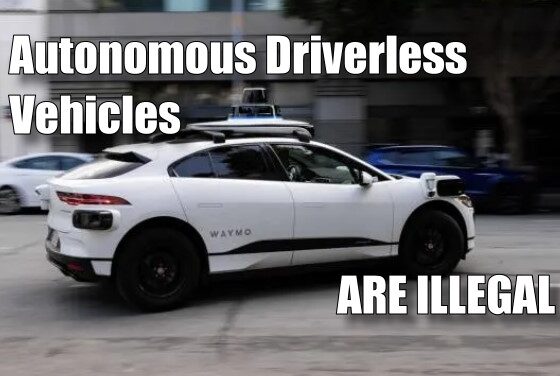
I don’t get it.
Something is driving a driverless vehicle. It can only be the operator of that vehicle. Just because it has no human operator does not mean someone or something is ‘in charge’. Whether the operator is doing it manually or technologically assisted the responsibility for that vehicle’s behavior rests on the operator. A driverless vehicle’s operator is its owner.
If you are a human you have to pass a driver’s test to receive the privilege of having a license to drive a vehicle on public roads. Driverless vehicle operators are NOT immune to law. If you do not have a license to drive on public roads, but you do it anyway: you can go to jail.
Just ask Brave: “Failure to have a valid driver’s license (often cited as “Driving While License Invalid” or “No Valid Driver’s License”) is generally treated as a criminal offense rather than a simple traffic infraction, with penalties escalating based on the specific circumstances and jurisdiction.
In Texas, operating a vehicle without a valid license is a Class C misdemeanor punishable by a fine of up to $500, though it can be enhanced to a Class B or Class A misdemeanor if the driver has prior offenses, was driving without insurance, or caused an accident resulting in injury or death (up to $4,000 fine and one year in jail). If a driver simply forgot their physical license but holds a valid one, the charge is often a “correctable offense” that can be dismissed upon presenting proof to the court, though an administrative fee may apply.
The severity of the charge depends heavily on the reason for the invalidity:
Never Licensed or Long-Term Expiration: In states like Florida, driving without ever obtaining a license or with one expired for more than six months is a second-degree misdemeanor.
Suspended or Revoked: Driving while a license is suspended, revoked, or canceled is typically a misdemeanor (or felony for repeat offenses in some states like Florida), requiring proof of “knowledge” of the suspension.
Expired (Short Term): Licenses expired for less than six months are often classified as civil infractions with lower fines, whereas expired licenses over this threshold trigger criminal charges.
New Residents: Most states, including Florida and New York, require new residents to obtain a local license within 30 days; failing to do so renders an out-of-state license invalid and can result in an NVDL charge.” [1]
A driverless vehicle has Never been Licensed. If you have a vehicle that drives itself and you are in it, you are responsible for that vehicle and must be attentive to it. A vehicle without a driver responsible can do whatever it wants.
A new resident in a state is required to acquire an in state license normally within 30 days of setting up domicile in that state. There is no difference between a human setting up domicile and a corporation setting up domicile. Yet a corporation can operate vehicles with no responsible licensed driver: … forever.
States cannot have it both ways.
Driverless vehicles are by their very intended purpose commercial vehicles. They either transport items or people. But none has a CDL. Isn’t a corporation a non-citizen? Just because driverless vehicle corporations are not illegal aliens does not mean they can be the very same thing and be scot free. [3]
Homeland Security is up in arms over states awarding Commercial Driver Licenses (CDL’s) to non- English speaking illegal alien people. There is no driverless vehicle that can speak English and what they can receive through artificial input is not reading, it is comparing to memory and acting according to the program’s instructions.
“To obtain a Commercial Driver’s License (CDL) in the United States, applicants must generally be at least 18 years old for intrastate driving and 21 years old for interstate commerce or transporting passengers. The process requires holding a valid non-commercial driver’s license, passing written knowledge tests and a practical driving skills test, and completing a DOT medical examination to receive a medical certificate.” [2]
Most states and local government no longer require vehicle inspections. There has never been a driverless vehicle that has completed a DOT medical (technical and mechanical) certification.
So why do humans need driver’s licenses and why do humans need to speak and read English to receive a CDL when machines doing the exact same thing, at the whim of their makers, under the control of their owners: do not?
“Entry-Level Driver Training (ELDT) is now mandatory for all first-time Class A or Class B CDL applicants issued a permit on or after February 7, 2022, requiring completion of training from an FMCSA-registered provider. Additionally, applicants must submit a 10-year driving history record from all states where they held a license, pass a background check, and self-certify their medical status.” [2]
But that’s human. There is no definition or requirement that a driver be human. Check your state. It is simply assumed. But not for driverless vehicles.
Every driverless vehicle using public roadways is ILLEGAL.
Either that, or governments requiring humans to have licenses are violating equal protection.
Just because it can be made does not mean it should and just because it is, does not mean it does not have to comply with the same requirements non automation requires.
If you have investment in a driverless vehicle. Too bad. Your machines will NEVER pass a driver’s test. The tester cannot converse with the driver. It would be like a blind and deaf person taking a driver’s test. That person can turn a wheel from nudges on their skin but that is not a license permission. Simple. Not gonna happen.
So:
While stupid investors are pouring cash into robot creations and driverless creations there has to be someone, somewhere who will establish a responsibility requirement. Government failing to do so is not behind the curve. I’d bet many politicians are victims of the same investment scams.
[1] https://search.brave.com/search?q=failure+to+have+a+valid+driver%27s+license
[2] https://search.brave.com/search?q=CDL+driver%27s+license+requirements
[3] https://homeland.house.gov/hearing/highway-safety-under-threat-examining-non-domiciled-cdl-issuance-to-illegal-aliens/